

RadioCult Breaks Down the Choice Between Managed and Self-Hosted Online Radio
News originally published by
EIN Presswire
RadioCult hosts and maintains the streaming setup, so stations can run broadcasting, scheduling and presenters without managing a server.

Managed plans are priced by storage, bandwidth and users, while self-hosted costs depend on the server provider and the time spent maintaining it.
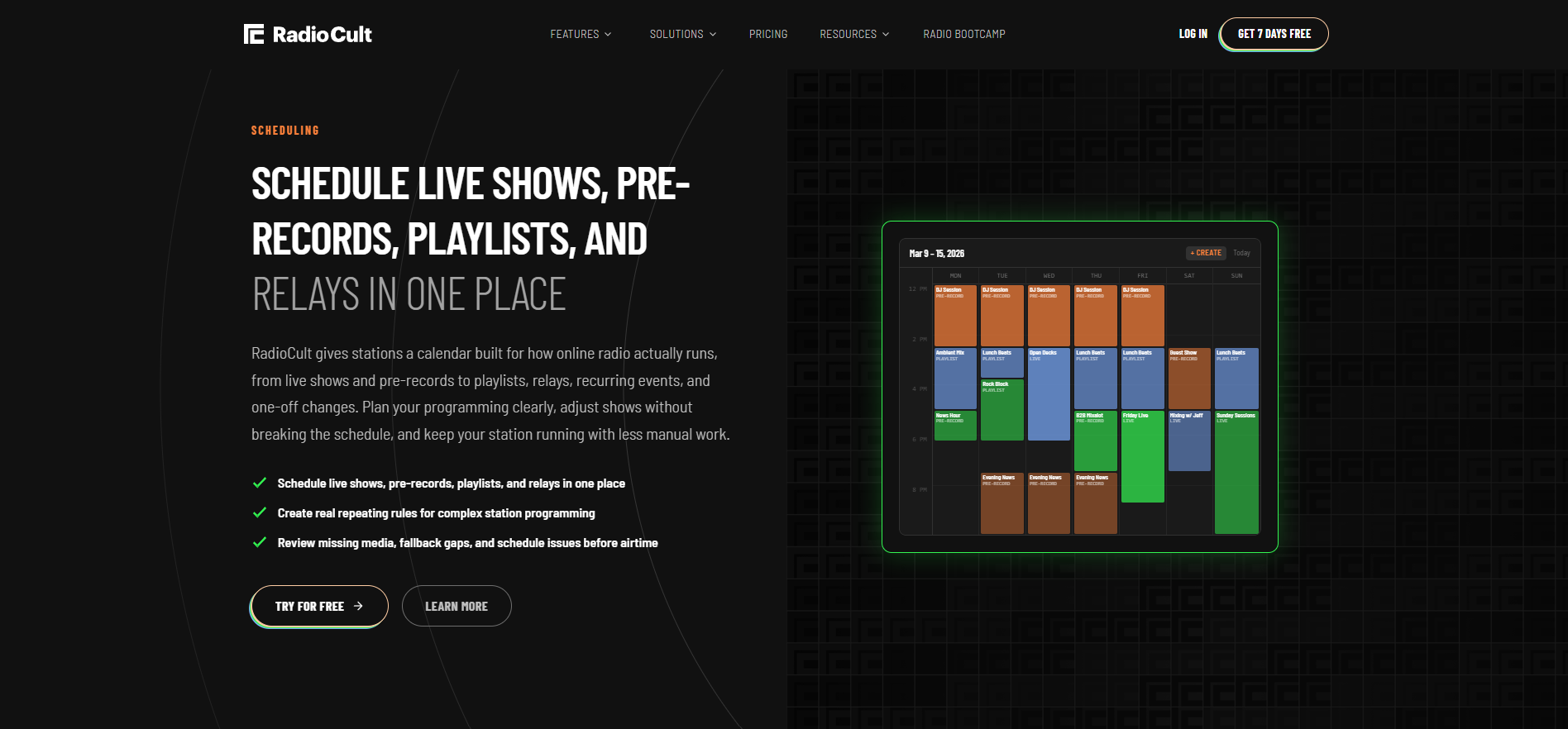
Stations moving off a self-hosted setup rebuild their schedule of live shows, pre-records and playlists using repeat rules.
Free server software, rented servers, stream hosting or a full platform: RadioCult sets out what each option costs and who keeps the station on air.
The four options sit on a line from full control to full hand-off. A home computer can stream a test broadcast, but its upload speed is limited and the station goes off air whenever the computer or the connection does, so it suits testing only. A self-hosted server, either a rented virtual private server or a dedicated machine, gives a technical team full control, along with responsibility for installation, security, updates, and outages. Stream hosting provides a managed Icecast or Shoutcast server, which covers the stream itself while scheduling, automation, and team tools are often limited or handled elsewhere. A radio platform combines streaming with scheduling, automation, analytics, and station management, in exchange for less low-level control over the server.
The software behind self-hosting is widely used and well established. Icecast is free and open source. Shoutcast is a long-established commercial product with its own licensing and plans. AzuraCast, also free and open source, bundles streaming software with a web interface for media, playlists, schedules, and listener statistics, and installs on a station's own server using Docker. Listeners do not see which server software a station uses, and any standard player can play the stream. According to RadioCult, the more important questions are how reliable the server is and who is responsible for keeping it running.
Cost is where the two approaches are most often misjudged. Free server software still needs a server running around the clock, and because each listener receives a separate copy of the stream, the capacity it needs grows with the audience. A 128 kbps stream with 100 concurrent listeners needs about 12.8 Mbps of upload, and 1,000 listeners need about 128 Mbps. If those 100 listeners stayed connected all month, the station would transfer just over 4 TB of data, which is what many hosts bill or cap. RadioCult's guidance is that the server bill is often not the largest cost. The larger one is time: applying updates, maintaining security, and resolving problems, work that usually falls to whichever team member understands the server.
Self-hosting remains the right call for some stations. A station with a technical member who enjoys the work, a need for full control over hosting, storage, and configuration, or several stations to run from one installation with custom roles and permissions can be well served by open-source software on its own server.
The balance tends to shift as a station grows. More presenters, more structured programming, and more listeners add to the coordination and capacity a self-hosted setup has to handle, and upkeep starts competing with programming for the same volunteers' time. Stations weighing alternatives to self-hosted radio streaming generally choose between two routes: stream hosting, which removes the server but leaves scheduling, automation, and presenter access to be assembled separately, or a radio platform that covers them together. RadioCult takes the second approach. It hosts and maintains the streaming setup and runs live shows, pre-records, playlists, relays, and AutoDJ from one shared schedule, alongside presenter roles, slot-based DJ access, analytics, chat, and embeddable players. Plans start at $33 a month.
Music licensing does not move with the server. Whether a station self-hosts or uses a managed platform, the station itself holds the licenses for the music it plays, and RadioCult does not bundle licensing into its plans. What changes is where the station's records come from. A self-hosted station assembles playout and listening records from its own server and automation software, while stations on RadioCult use its scheduling tools, reports, and analytics to keep the playout logs that collecting societies often require to calculate royalties.
For stations that decide to move, there is no automatic import between hosting setups, but the switch does not have to happen at once. RadioCult's guidance on moving from Shoutcast and similar setups describes a staged approach: upload the next few shows and bring the archive across over time, rebuild the schedule using repeat rules, then update the stream link wherever listeners tune in, including website players, apps, and directories. Some stations run both setups while listeners move across, or relay the existing stream into the new platform while the schedule is rebuilt.
"Self-hosting works well when someone on the team wants to run the server and has the time to do it," said a RadioCult spokesperson. "The useful question is who keeps the station on air when something breaks, and whether that is the best use of their time."
RadioCult suggests stations settle four questions before choosing: who will maintain the server and who covers when that person is away, how many listeners the station expects at its peak, which tools beyond the stream it needs, such as scheduling, automation, and presenter access, and how it will keep the records its music licenses require. According to RadioCult, a station that can answer the first question with confidence has a real case for self-hosting, and one that cannot is usually better served by a managed option. Every RadioCult plan can be tried for seven days.
About RadioCult
RadioCult is an online radio hosting platform built for independent and community stations that broadcast 24/7 with multiple presenters. It combines live and automated broadcasting, radio-native scheduling, station and artist management, and unlimited concurrent listeners in one platform, with human support and pricing that starts at $33 per month. Learn more at https://www.radiocult.fm.
Corey Haines
Conversion Factory
Visit us on social media:
Instagram
Facebook
X
Legal Disclaimer:
EIN Presswire provides this news content "as is" without warranty of any kind. We do not accept any responsibility or liability for the accuracy, content, images, videos, licenses, completeness, legality, or reliability of the information contained in this article. If you have any complaints or copyright issues related to this article, kindly contact the author above.
