

New framework sharpens satellite positioning against ionospheric interference
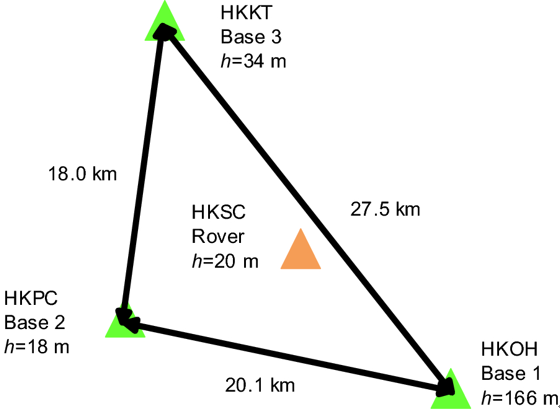
Configuration of reference and rover stations in the network RTK system.
FAYETTEVILLE, GA, UNITED STATES, July 3, 2026 /EINPresswire.com/ -- Centimeter-level satellite positioning is becoming essential for autonomous transport, precision surveying, unmanned aerial vehicles, and other systems that must know exactly where they are in real time. Yet even advanced multi-frequency Global Navigation Satellite Systems (GNSS) can lose reliability when residual atmospheric perturbations distort carrier-phase signals. This study develops an enhanced sensitivity analysis framework for Geometry-Free (GF) Three-Carrier Ambiguity Resolution (TCAR), a method used to fix the integer ambiguities behind high-precision positioning. By quantifying how residual ionospheric error, tropospheric error, and measurement noise affect each ambiguity-resolution step, the work provides practical thresholds for making network Real-Time Kinematic (RTK) positioning more robust.
High-precision Global Navigation Satellite Systems (GNSS) positioning depends on resolving integer ambiguities in carrier-phase observations. Modern satellite constellations, including Global Positioning System (GPS), Galileo, and BeiDou Navigation Satellite System (BDS), now transmit multiple frequencies, creating new opportunities for geometry-free ambiguity resolution. In network Real-Time Kinematic (RTK), reference stations estimate atmospheric corrections and transmit them to users. However, residual errors often persist, especially across medium and long baselines or in low-latitude regions with active ionospheric conditions. Even small unmodeled ionospheric effects can determine whether a positioning system reaches centimeter-level accuracy or falls back to less precise results. Due to these challenges, the impact of residual atmospheric errors and noise on GF-TCAR needs to be investigated in depth.
A research team from the Department of Land Surveying and Geo-Informatics at The Hong Kong Polytechnic University and the College of Civil Aviation at Nanjing University of Aeronautics and Astronautics reported (DOI: 10.1186/s43020-026-00202-2) the study in Satellite Navigation on June 22, 2026. The article examines how residual ionospheric and tropospheric errors influence GF TCAR performance, using theoretical derivations, simulations, and field data from network RTK experiments.
The study breaks TCAR into its cascading ambiguity-resolution stages: Extra-Wide-Lane (EWL), Wide-Lane (WL), and Narrow-Lane (NL). Rather than assessing each signal combination in isolation, the proposed framework evaluates the composite error passed from one stage to the next, which more accurately reflects how TCAR works in practice. The results show a clear hierarchy of sensitivity. Tropospheric delay, a non-dispersive atmospheric error, is effectively mitigated in the GF model and has negligible influence on ambiguity resolution. Conversely, ionospheric error is the dominant constraint. EWL ambiguity remains stable even when residual ionospheric error reaches several tens of Total Electron Content Units (TECU), and WL ambiguity can tolerate several TECU. NL ambiguity, however, requires much stricter control: residual ionospheric error must generally stay within about ±0.2 TECU for reliable fixing. The team also found that EWL is highly resistant to measurement noise, while WL becomes noise-limited, particularly when longer EWL wavelengths amplify carrier-phase noise. Simulations across GPS, Galileo, and BDS, together with Hong Kong network RTK field experiments under quiet and active ionospheric periods, confirmed these thresholds and showed why low-latitude environments require especially careful ionospheric quality control.
The authors noted that the framework gives navigation engineers a clearer way to decide when atmospheric corrections are good enough for reliable ambiguity resolution. “ In real-time high-precision positioning, the question is not just whether an ionospheric model is accurate, but exactly how accurate it needs to be for each successive step of ambiguity fixing,” they explained. “By turning residual errors into quantitative tolerance thresholds, this work helps identify the weakest link in the TCAR process and offers a practical basis for improving multi-frequency GNSS services.”
These findings could support more dependable network RTK services for autonomous driving, aerial robotics, marine navigation, construction, deformation monitoring, and other applications that need fast, precise positioning beyond short baselines. The ±0.2 TECU benchmark for NL ambiguity provides a concrete target for evaluating ionospheric models, while the noise analysis can guide receiver design, signal-combination selection, and quality control in challenging environments such as urban areas or regions with strong ionospheric activity. More broadly, the framework can be adapted to other geometry-free models and frequency combinations, helping future GNSS systems maintain accuracy as navigation moves into more demanding real-world settings.
References
DOI
10.1186/s43020-026-00202-2
Original Source URL
https://doi.org/10.1186/s43020-026-00202-2
Lucy Wang
BioDesign Research
email us here
Legal Disclaimer:
EIN Presswire provides this news content "as is" without warranty of any kind. We do not accept any responsibility or liability for the accuracy, content, images, videos, licenses, completeness, legality, or reliability of the information contained in this article. If you have any complaints or copyright issues related to this article, kindly contact the author above.
