

Bone-grafting biomaterial that selectively destroys bone cancer cells and bacteria
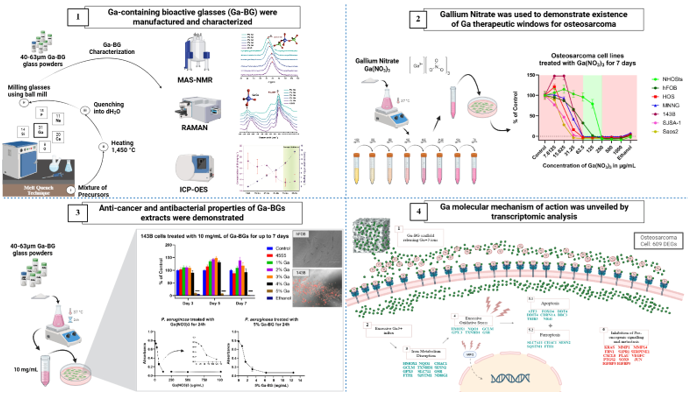
Figure 1. Graphical abstract summarising study methodology and its main findings. Gallium-containing bioactive glasses (Ga-BGs) were produced by the melt-quenching technique and characterised by MAS-NMR and RAMAN spectroscopy.
FAYETTEVILLE, GA, UNITED STATES, July 3, 2026 /EINPresswire.com/ -- Researchers have engineered a multifunctional gallium-doped bioactive glass that selectively kills osteosarcoma cells and prevents bacterial infections while promoting bone regeneration. By localized delivery of gallium ions, this innovative biomaterial disrupts iron metabolism in cancer cells, triggering programmed cell death without harming healthy bone tissue. It simultaneously provides a robust defense against hospital-acquired pathogens like Pseudomonas aeruginosa.
Primary bone tumors, such as osteosarcoma, have seen stagnant survival rates over the past four decades. Surgical removal of the tumor is critical, but local recurrence may occur when tumours are close to vital structures, often resulting in amputation. Furthermore, these surgeries are associated with significant bone loss and implant failure due to infection.
An international team of researchers led by the Royal Orthopaedic Hospital NHS Foundation Trust, Aston University, and the Brazilian Aeronautics Institute of Technology, has developed an advanced synthetic grafting material. By incorporating gallium oxide into the traditional "Bioglass 45S5" matrix, they created a multi-functional material that simultaneously eradicates residual cancer cells, prevents bacterial colonisation, and regenerates missing bone tissue.
“Our multi-functional biomaterial acts as a localised drug delivery system (Figure 1.1), offering a therapeutic strategy to selectively destroy residual tumour cells where the surgery took place, while providing calcium, phosphate, and silicon ions needed to grow back healthy bone,” explains Dr Lucas Souza, the study's principal investigator from the Royal Orthopaedic Hospital NHS Foundation Trust (Figure 1.2).
“This development leads us into new frontiers of both therapeutics and prophylaxis against the most devasting complications of limb-salvage surgery, specifically local recurrence and infection, which threaten limbs and compromise patient survival” says co-author Jonathan Stevenson, Consultant Orthopaedic oncology surgeon at the Royal Orthopaedic Hospital.
Through high-throughput RNA sequencing, the team uncovered a highly selective molecular mechanism. “Because bone cancer cells overexpress transferrin receptors to fuel their rapid growth, they absorb four to eight times more gallium than healthy cells,” says Souza. “Once inside the malignant cells, gallium mimics iron but cannot participate in essential redox reactions. This causes immediate iron depletion, overwhelming oxidative stress, and a catastrophic cellular crisis that forces the cancer cells down apoptotic and ferroptotic self-destruction pathways (Figure 1.4).”
In contrast, healthy bone cells easily manage the temporary stress via natural antioxidant mechanisms and fully recover within days.
Beyond its potent anti-cancer properties, the material also aids in preventing surgical site infection. “The optimal 5% gallium glass formulation completely inhibited the growth of the aggressive, gram-negative pathogen Pseudomonas aeruginosa,” shares Stevenson (Figure 1.3). “This dual therapeutic action effectively seals off the surgical site from deadly hospital-acquired infections while the glass degrades to make space for brand new bone.
References
DOI
10.1016/j.engreg.2026.05.001
Original Source URL
https://doi.org/10.1016/j.engreg.2026.05.001
Funding Information
This work was supported by Bone Cancer Research Trust (BCRT) [BCRT7921]; Royal Orthopaedic Hospital Charity [#135]; Orthopaedic Research UK [ORUK:594], RAEng/Leverhulme Trust Senior Research Fellowship [Developing bioactive glasses for bone cancer therapy], Paediatric Cancer Research programme at UEA, Brazilian National Council for Scientific and Technological Development (CNPq) [444922/2024-5] and Sao Paulo Research Foundation (FAPESP) [2022/03247-6, 2023/07910-4, and 2025/01038-9].
Lucy Wang
BioDesign Research
email us here
Legal Disclaimer:
EIN Presswire provides this news content "as is" without warranty of any kind. We do not accept any responsibility or liability for the accuracy, content, images, videos, licenses, completeness, legality, or reliability of the information contained in this article. If you have any complaints or copyright issues related to this article, kindly contact the author above.
