

Glycerin Market Projected to Expand from USD 4,280 Million in 2025 to USD 6,890 Million by 2035 | CAGR of 4.87%
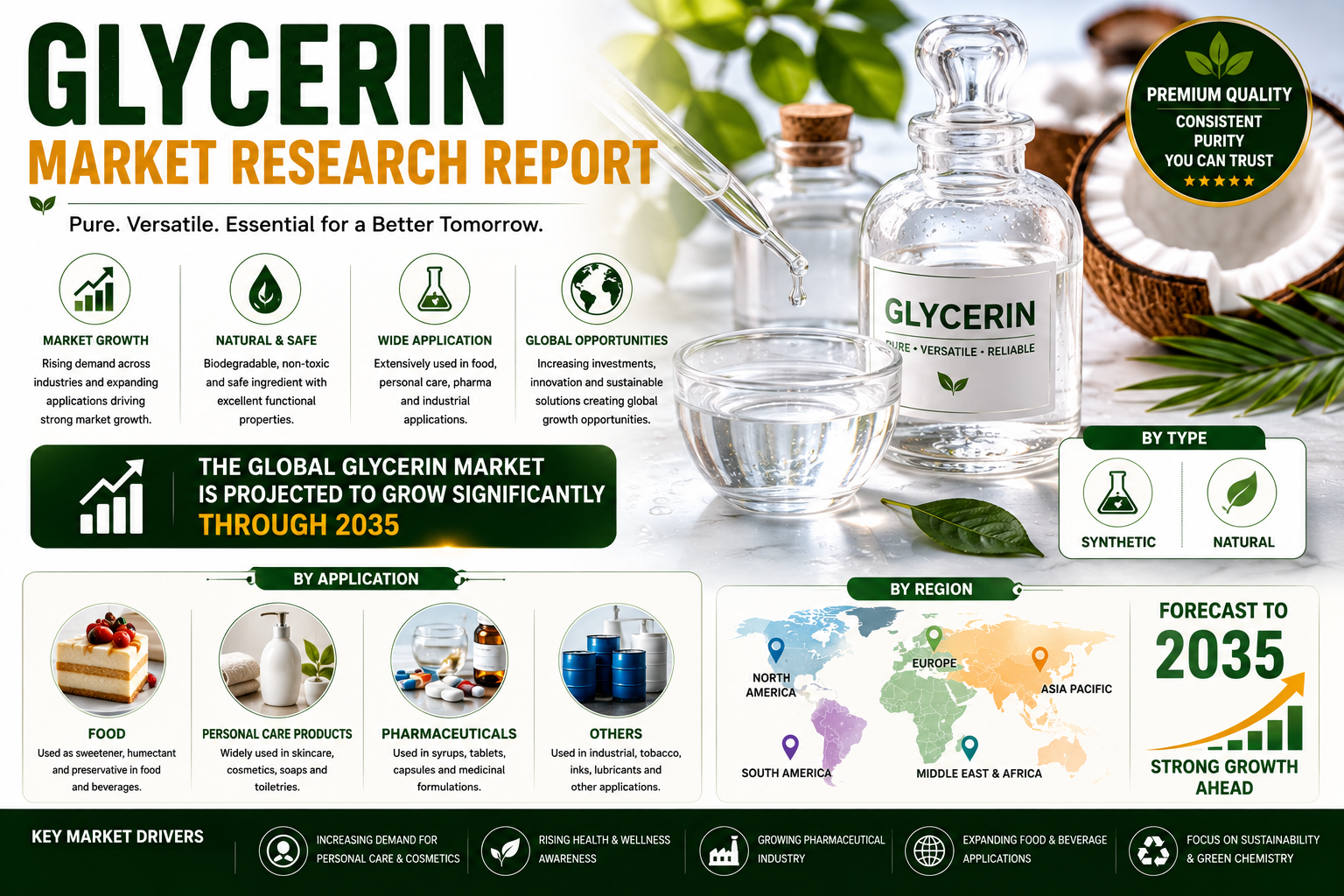
Glycerin Market
Asia-Pacific captured 52.8% of global volume in 2025 and is set to expand at a 5.47% CAGR.
EUROPE, FRANCE, June 19, 2026 /EINPresswire.com/ -- The global glycerin market is witnessing steady expansion due to rising demand from pharmaceuticals, personal care, food & beverages, and industrial sectors. Glycerin, also known as glycerol, is a versatile polyol widely used for its moisturizing, sweetening, and stabilizing properties. Increasing focus on bio-based and sustainable chemicals, along with the rapid growth of biodiesel production, has significantly boosted glycerin availability and applications worldwide.According to Market Research Future, the global glycerin market was valued at USD 4,280 Million in 2025 and is projected to grow from USD 4,490 Million in 2026 to USD 6,890 Million by 2035, registering a CAGR of 4.87% during the forecast period (2026–2035).
Market Overview, Size and CAGR
The glycerin market is evolving as a critical segment within the specialty chemicals industry. Its demand is strongly linked to both industrial production and consumer-driven sectors. Glycerin is primarily obtained as a by-product of biodiesel manufacturing, which has significantly increased global supply and improved cost efficiency.
Between 2026 and 2035, the market is expected to grow steadily from USD 4,490 Million to USD 6,890 Million, reflecting stable long-term demand across multiple industries. The 4.87% CAGR indicates moderate but consistent growth supported by diversified applications rather than dependency on a single end-use industry.
One of the key growth drivers is the increasing demand from the personal care and cosmetics industry, where glycerin is used as a humectant in creams, lotions, soaps, and hair care products. Its ability to retain moisture and improve skin hydration makes it a preferred ingredient in skincare formulations.
The pharmaceutical sector also plays a crucial role in market expansion. Glycerin is widely used in syrups, ointments, capsules, and medical formulations due to its non-toxic and safe properties. Additionally, its role as a sweetener and preservative in the food and beverage industry further strengthens its market demand.
Industrial applications, including resins, antifreeze, and chemical intermediates, continue to contribute steady consumption. Moreover, increasing global emphasis on sustainable and bio-based products is accelerating the shift from synthetic chemicals to natural glycerin sources.
Overall, the market demonstrates a balanced growth structure supported by both consumer-facing and industrial applications, ensuring long-term stability through 2035.
Download Report Sample Copy with TOC: https://www.marketresearchfuture.com/sample_request/2392
Key Market Segments (Detailed Analysis)
The glycerin market is segmented based on type, application, and region, each playing a significant role in shaping overall demand patterns.
By Type
The market is divided into:
Natural Glycerin
Synthetic Glycerin
Natural glycerin dominates the market due to its widespread use in food, pharmaceuticals, and personal care products. Derived mainly from vegetable oils and biodiesel production, natural glycerin is preferred for its eco-friendly and non-toxic characteristics. Growing consumer preference for clean-label and plant-based ingredients further strengthens this segment.
Synthetic glycerin, although smaller in share, is used in industrial applications where cost efficiency is more important than purity. It is mainly utilized in chemical manufacturing, antifreeze products, and technical formulations.
By Application
1. Personal Care Products
This is the largest application segment, accounting for a significant share of global demand. Glycerin is widely used in moisturizers, lotions, soaps, shampoos, and cosmetics due to its strong hydrating and skin-protecting properties. Increasing consumer awareness regarding skincare and natural ingredients is boosting this segment.
2. Pharmaceuticals
The pharmaceutical segment is experiencing strong growth. Glycerin is used in cough syrups, capsules, suppositories, and ointments due to its solvent and stabilizing properties. Rising healthcare expenditure globally is further driving demand.
3. Food Industry
In the food sector, glycerin is used as a sweetener, humectant, and preservative. It helps maintain moisture in bakery products, confectionery, and processed foods, improving shelf life and texture.
4. Others (Industrial Applications)
Industrial uses include antifreeze, resins, lubricants, and chemical intermediates. While smaller in share, this segment provides stable and continuous demand from manufacturing industries.
Regional Insights (Value & Market Share Analysis)
The global glycerin market shows strong regional diversity:
Asia-Pacific
Asia-Pacific dominates the global market with an estimated 35–40% share, driven by strong biodiesel production, expanding cosmetics manufacturing, and rapid industrialization. Countries like China, India, Indonesia, and Malaysia are major contributors.
North America
North America holds around 25–30% market share, supported by strong pharmaceutical, food processing, and personal care industries. The United States remains the key consumer due to high demand for processed food and skincare products.
Europe
Europe accounts for approximately 20–25% share, driven by strict environmental regulations and rising adoption of bio-based chemicals. Germany, France, and the UK are major markets.
Rest of the World
Latin America and the Middle East & Africa collectively hold about 10–12% share, with gradual growth driven by industrial development and increasing consumer goods demand.
Future Opportunities
The glycerin market presents strong future opportunities driven by sustainability trends and expanding industrial applications. Increasing demand for bio-based and biodegradable materials will create new growth avenues. Pharmaceutical-grade glycerin is expected to see strong adoption due to rising healthcare needs.
Emerging applications in green chemicals, energy storage systems, and advanced cosmetics formulations are also expected to support market expansion. Additionally, technological advancements in glycerin purification will enhance product quality and broaden its application scope.
Industry Expert Perspective
Industry experts highlight that glycerin is transitioning from a commodity by-product to a high-value specialty ingredient. The rapid expansion of biodiesel production has created a stable and abundant supply base, but also introduced challenges related to crude glycerin oversupply.
Experts emphasize that advancements in refining technologies are enabling manufacturers to convert low-grade glycerin into high-purity pharmaceutical and food-grade products, increasing profitability.
Furthermore, the shift toward sustainable and plant-based ingredients is reshaping global demand patterns. Experts believe Asia-Pacific will continue to dominate production due to cost advantages and strong manufacturing infrastructure, while developed markets will focus on innovation and regulatory compliance.
Overall, glycerin is expected to remain a key material in the global transition toward greener chemical solutions.
Buy Now: https://www.marketresearchfuture.com/checkout?currency=one_user-USD&report_id=2392
Competitive Landscape
The glycerin market is moderately consolidated with several global and regional players competing across production, refining, and distribution. Key companies include BASF SE, Cargill Incorporated, Dow Chemical Company, Wilmar International, Emery Oleochemicals, Solvay S.A., Kraton Corporation, and Procter & Gamble.
These companies focus on strategies such as capacity expansion, vertical integration, and partnerships with biodiesel producers to secure raw material supply. Investments in high-purity glycerin production and sustainable manufacturing processes are also increasing.
Competition is intensifying as companies aim to capture demand from high-value segments such as pharmaceuticals and personal care. Innovation, product quality, and supply chain efficiency remain the key differentiators in this evolving market landscape.
Related Report
Emulsion Polymers Market https://www.marketresearchfuture.com/reports/emulsion-polymers-market-2206
Lubricant Additives Market https://www.marketresearchfuture.com/reports/lubricant-additives-market-2179
Specialty Silica Market https://www.marketresearchfuture.com/reports/specialty-silica-market-2159
Salicylic Acid Market https://www.marketresearchfuture.com/reports/salicylic-acid-market-2156
Succinic Acid Market https://www.marketresearchfuture.com/reports/succinic-acid-market-1914
Market Research Future
Market Research Future
+ +1 855-661-4441
email us here
Visit us on social media:
LinkedIn
Facebook
X
Legal Disclaimer:
EIN Presswire provides this news content "as is" without warranty of any kind. We do not accept any responsibility or liability for the accuracy, content, images, videos, licenses, completeness, legality, or reliability of the information contained in this article. If you have any complaints or copyright issues related to this article, kindly contact the author above.
