

Following the news from Europe
Provided by AGP
Restriction Enzymes Market to Reach US$411.4 Million by 2033 at 7.3% CAGR
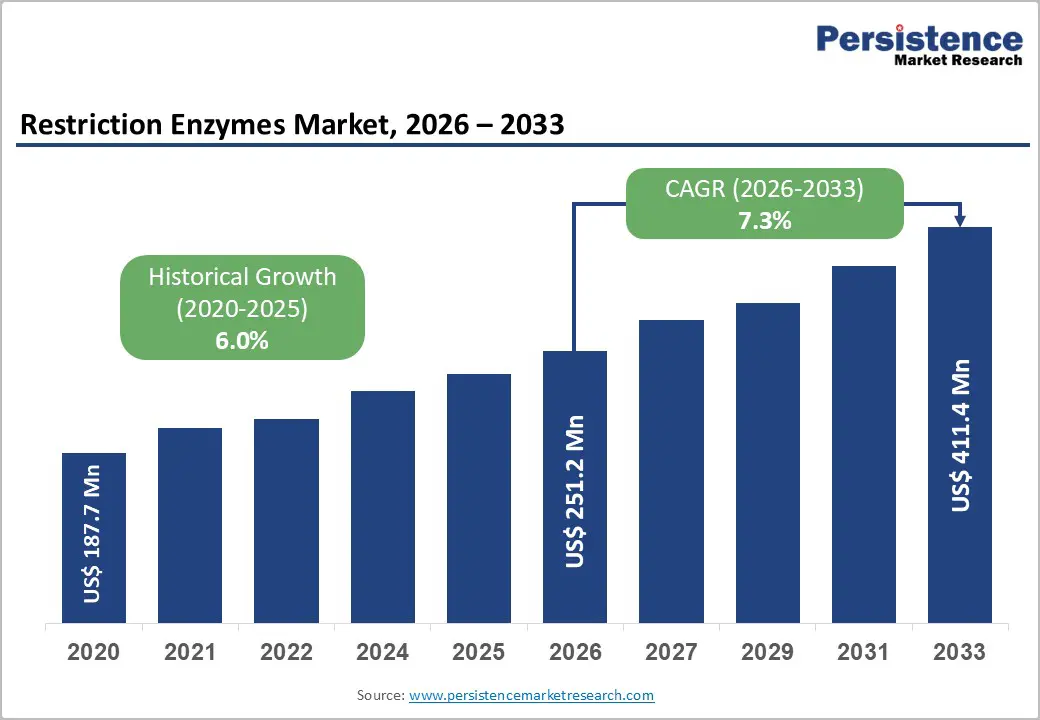
Restriction Enzymes Market
Restriction Enzymes Market to reach US$411.4 Mn by 2033, driven by genomics, cloning, molecular diagnostics, and biotech research.
BRENFORD, LONDON, UNITED KINGDOM, May 20, 2026 /EINPresswire.com/ -- The global Restriction Enzymes Market is gaining steady momentum as molecular biology, genetic engineering, cloning, sequencing, and diagnostic research continue to expand across biotechnology and life sciences. Restriction enzymes remain essential tools for cutting DNA at specific recognition sites, enabling researchers to analyze, modify, and assemble genetic material with precision. According to Persistence Market Research, the global restriction enzymes market size is likely to be valued at US$251.2 million in 2026 and is expected to reach US$411.4 million by 2033, growing at a CAGR of 7.3% between 2026 and 2033.
Market growth is supported by rising demand from academic research institutes, pharmaceutical companies, biotechnology laboratories, and clinical research organizations. The leading segment is expected to remain conventional restriction enzymes due to their wide use in cloning, DNA mapping, and molecular diagnostics. North America is likely to remain a leading geographical region, supported by strong biotech infrastructure, advanced research funding, and high adoption of molecular biology tools.
Want Market Insights? Get Your Free Report Sample : https://www.persistencemarketresearch.com/samples/36549
Key Highlights from the Report
➤ The Restriction Enzymes Market is projected to grow from US$251.2 million in 2026 to US$411.4 million by 2033 at a CAGR of 7.3%.
➤ Increasing use of restriction enzymes in DNA cloning and gene editing is strengthening market demand.
➤ Biotechnology and pharmaceutical research laboratories remain major end users of restriction enzymes.
➤ Growing molecular diagnostics applications are creating new demand for accurate DNA-cutting tools.
➤ North America leads due to advanced genomics research and strong life sciences investments.
➤ Asia Pacific is emerging as a promising region due to expanding biotech research capabilities.
Market Segmentation
The restriction enzymes market can be segmented by product type, including type I, type II, type III, and type IV restriction enzymes. Type II restriction enzymes are widely used because they cut DNA at defined sites, making them highly suitable for cloning, sequencing preparation, gene analysis, and recombinant DNA technology. Their reliability and ease of use make them a preferred choice in research laboratories.
By end user, the market includes academic and research institutes, pharmaceutical companies, biotechnology companies, and diagnostic laboratories. Academic and research institutes hold strong demand due to continuous molecular biology studies, while biotech and pharma companies use restriction enzymes for drug discovery, biologics development, and genetic engineering workflows.
Customize This Report for Your Exact Requirements : https://www.persistencemarketresearch.com/request-customization/36549
Regional Insights
North America remains a key market for restriction enzymes due to strong research funding, established biotechnology companies, and advanced genomics infrastructure. The region benefits from continuous innovation in molecular diagnostics, synthetic biology, and life sciences research.
Asia Pacific is expected to show strong growth as countries invest in biotechnology, genomics, and healthcare research. Expanding academic research, rising laboratory automation, and growing demand for affordable molecular biology tools are supporting regional market expansion.
Market Drivers
The main driver of the Restriction Enzymes Market is the rising use of molecular biology techniques in healthcare, agriculture, biotechnology, and pharmaceutical research. Restriction enzymes are essential for DNA manipulation, enabling cloning, gene mapping, mutation analysis, and recombinant DNA development.
Growing demand for genetic testing and molecular diagnostics is also supporting market growth. As precision medicine and genomics-based research expand, laboratories require reliable enzymes that deliver accurate and reproducible DNA processing results.
Market Restraints
A key restraint is the availability of alternative gene editing and DNA manipulation technologies that may reduce dependence on traditional restriction enzyme workflows. Advanced tools can sometimes offer faster or more flexible genetic modification methods.
Another challenge is the need for high-quality storage, handling, and temperature control. Enzyme sensitivity can affect performance, increasing operational care requirements for laboratories and suppliers.
Unlock Complete Insights – Buy the Full Report : https://www.persistencemarketresearch.com/checkout/36549
Market Opportunities
The market has strong opportunities in synthetic biology, personalized medicine, and advanced diagnostics. As researchers develop new genetic platforms, restriction enzymes will remain important in DNA assembly and validation workflows.
Emerging economies also offer growth potential as biotechnology education, research funding, and diagnostic laboratory networks expand. Suppliers offering cost-effective, high-purity enzymes can gain stronger adoption.
Company Insights
Key players operating in the market include Thermo Fisher Scientific, New England Biolabs, Merck KGaA, Takara Bio, Promega Corporation, Agilent Technologies, Bio-Rad Laboratories, QIAGEN, Roche, and Illumina.
Explore the Latest Trending Research Reports:
Sleep Aids Market
Treatment Syndromes Dementia Movement Disorders Market
Persistence Market Research
Persistence Market Research Pvt Ltd
+1 646-878-6329
email us here
Visit us on social media:
LinkedIn
Instagram
Facebook
YouTube
X
Legal Disclaimer:
EIN Presswire provides this news content "as is" without warranty of any kind. We do not accept any responsibility or liability for the accuracy, content, images, videos, licenses, completeness, legality, or reliability of the information contained in this article. If you have any complaints or copyright issues related to this article, kindly contact the author above.
