

Following the news from Europe
Provided by AGP
Strategic Pragmatism and AI Governance: Paul Saunders with Sanjay Puri on RegulatingAI podcast

RegulatingAI Podcast
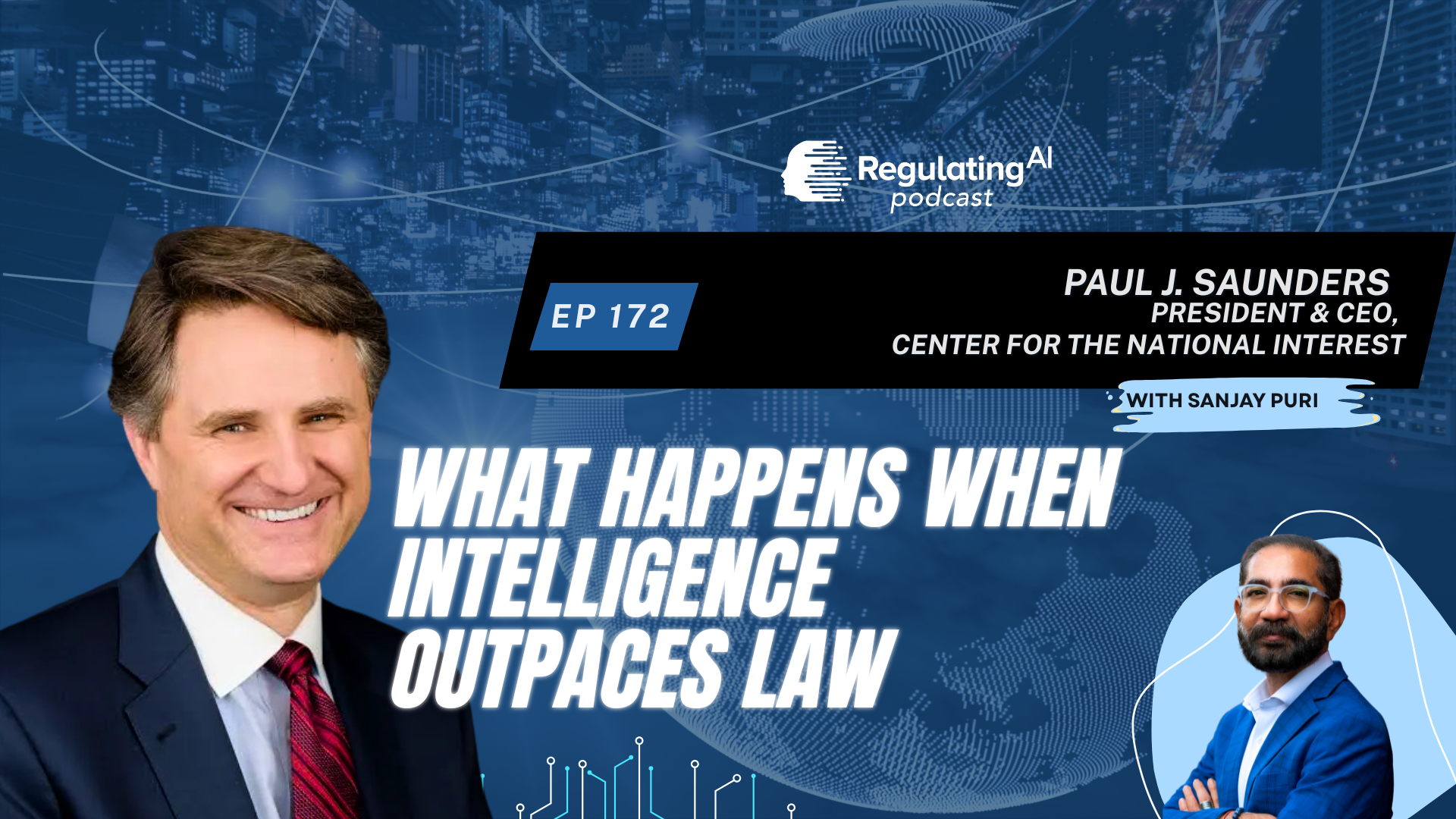
Paul J. Sanders, President and CEO of the Center for the National Interest, with Sanjay Puri, President of RegulatingAI
On the RegulatingAI podcast, Paul Saunders tells Sanjay Puri AI needs forward-looking rules, balancing innovation, energy, and global competition.
WASHINGTON, DC, UNITED STATES, May 4, 2026 /EINPresswire.com/ -- In a thought-provoking episode of the RegulatingAI podcast, host Sanjay Puri speaks with Paul J. Saunders, President and CEO of the Center for the National Interest, about the fast-changing world of artificial intelligence governance. Saunders, who represents the Center for the National Interest, explains how policymakers struggle to keep pace with rapid technological change. The discussion highlights key tensions between innovation, regulation, and global competition.Saunders begins by describing his organization as a non-partisan think tank founded by Richard Nixon. He explains that the center promotes strategic and pragmatic thinking in foreign policy. This perspective shapes his views on AI governance, which he sees as part of a larger historical pattern. He compares today’s AI boom to the Industrial Revolution. In both cases, innovation moved faster than regulation, creating both benefits and risks. He argues that AI development now moves even faster than past technological shifts. This speed creates a major challenge for democratic systems like the United States. Governments often react slowly, while technology spreads quickly across borders. Saunders says policymakers should not try to “catch up.” Instead, they should think ahead and design flexible guardrails.
The conversation also explores global competition, especially with China. Saunders stresses that AI is not just a domestic issue. It plays a central role in national security and economic power. He warns that overregulation could weaken the United States in this competition. At the same time, he acknowledges the need for some safeguards. He believes policymakers must strike a careful balance between innovation and control. On domestic policy, Saunders supports a mixed approach. He likes the idea of U.S. states acting as “laboratories of democracy,” where different rules can be tested. However, he also sees the need for federal standards in areas tied to national security. This balance reflects the broader challenge of AI governance: deciding when to centralize and when to decentralize authority.
Energy emerges as another critical theme. Saunders highlights the growing power demands of AI data centers. He supports nuclear energy as a reliable and clean option. He notes that nuclear power can provide stable, 24/7 electricity, which AI systems require. However, he also points out the difficulty of building new nuclear plants in the United States. Despite these challenges, he remains optimistic about future progress. The discussion turns to public resistance against data centers. Saunders uses a simple analogy: people want the benefits of AI but not the infrastructure near them. He argues that demand drives the expansion of data centers. To manage this, companies may build dedicated power sources instead of relying on public grids. This approach could reduce pressure on consumers’ electricity costs.
On international governance, Saunders expresses cautious support. He believes global cooperation on AI rules is important but difficult to achieve. Different countries have competing interests, especially in a high-stakes race like AI. Without a strong enforcement mechanism, international agreements may remain weak. The episode also addresses the growing power of private companies. Saunders notes that firms like Anthropic and OpenAI now influence global policy decisions. He sees this as a major shift from the past, when governments led technological development. While he values market systems, he stresses the need for transparency and accountability.
In the lightning round, Saunders clearly favors innovation over strict regulation. He calls the EU AI Act a cautionary tale and supports companies’ rights to set terms for their technologies. However, he raises concerns about AI in military use, especially the lack of meaningful human oversight.
Overall, the conversation on the RegulatingAI podcast presents a balanced view of AI governance. Paul Saunders emphasizes forward-thinking policies, global awareness, and the importance of maintaining both innovation and responsibility in a rapidly evolving world.
Upasana Das
Knowledge Networks
email us here
Visit us on social media:
LinkedIn
Instagram
Facebook
YouTube
X
Legal Disclaimer:
EIN Presswire provides this news content "as is" without warranty of any kind. We do not accept any responsibility or liability for the accuracy, content, images, videos, licenses, completeness, legality, or reliability of the information contained in this article. If you have any complaints or copyright issues related to this article, kindly contact the author above.
