

Genome-wide screen reveals a universal role of ATP in ciprofloxacin tolerance among distinct Escherichia coli persisters
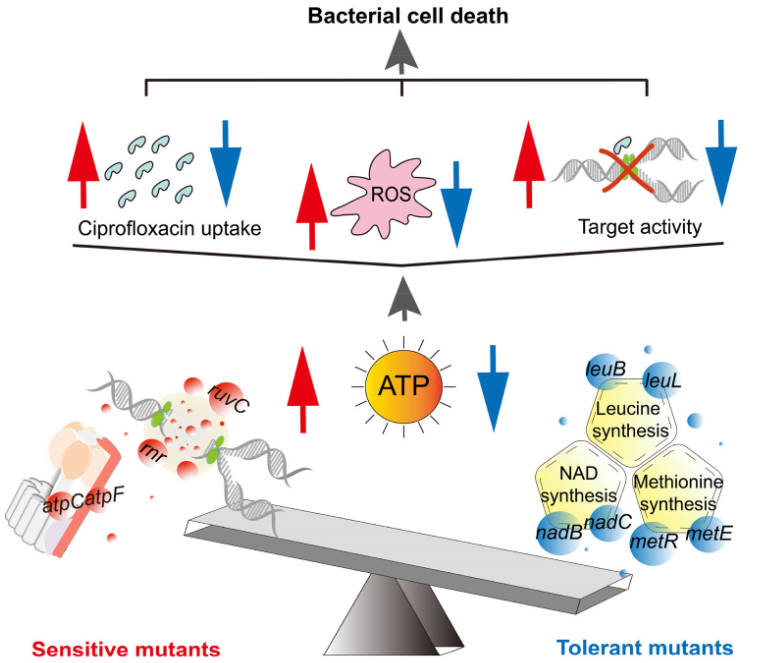
Schematic illustration of ATP‐regulated ciprofloxacin persistence in genetically distinct persisters.
GA, UNITED STATES, March 24, 2026 /EINPresswire.com/ -- This study demonstrates that numerous genes modulate the antibiotic survival of bacterial persister cells, a major contributor to recurrent and chronic bacterial infections. Nevertheless, the critical determinant for ciprofloxacin tolerance among genetically distinct persisters is cellular ATP level: lower ATP levels are associated with increased ciprofloxacin tolerance, whereas ATP elevation through nutrient supplementation enhances ciprofloxacin efficacy against persisters. This study not only provides novel insights into the mechanisms of ciprofloxacin tolerance in bacterial persisters but also hints nutritional interventions as a potential strategy for the treatment of recurrent and chronic infections.
Persisters are a bacterial subpopulation that exhibits tolerance to antibiotics and plays a critical role in chronic and recurrent infections. However, the general mechanisms underlying persister formation and antibiotic tolerance remain poorly understood. Dissection of the underlying mechanisms is essential for developing effective therapeutic strategies against persister-associated infections.
In this study, the authors employed a two-step genome-wide screening strategy using the Escherichia coli Keio single-gene deletion library to systematically identify genes associated with ciprofloxacin tolerance. Each mutant was cultured to late stationary phase to induce persister formation, then diluted into fresh medium and treated with antibiotics, eventually allowing the identification of 37 ciprofloxacin-sensitive mutants (primarily involved in DNA repair and energy metabolism) and 11 ciprofloxacin-tolerant mutants (mainly associated with amino acid and NAD synthesis). Among these, 25 genes were linked to persistence for the first time. Sensitive mutants (ΔruvC, Δrnr, ΔatpC, and ΔatpF) showed specific sensitivity to quinolones, while tolerant mutants (ΔmetR, ΔmetE, ΔleuB, ΔleuL, ΔnadB, and ΔnadC) also exhibited tolerance to ampicillin and gentamicin.
Further analysis revealed a negative correlation between ATP levels and ciprofloxacin tolerance across genetically distinct mutants: ATP levels were down-regulated in tolerant mutants and up-regulated in sensitive ones. This relationship held true even when ATP levels were chemically modulated using metabolites, nutrients, or respiratory inhibitors. Moreover, ciprofloxacin persistence was closely associated with reduced antibiotic uptake and lower reactive oxygen species (ROS) accumulation.
These findings highlight a universal regulatory role of ATP in ciprofloxacin tolerance across diverse genetic backgrounds, likely through modulating antibiotic uptake and ROS accumulation. This work not only provides new insights into persister biology but also suggests that nutrient-rich conditions may help eradicate persisters in clinical settings. Future strategies targeting ATP modulation could offer novel approaches for managing recurrent and chronic infections.
DOI
10.1002/mlf2.70072
Original Source URL
https://doi.org/10.1002/mlf2.70072
Funding information
This work was supported by the grants from the National Natural Science Foundation of China (No. 82372295 to X.F.) and the Innovation Star of Fujian Province (to X.F.).
Lucy Wang
BioDesign Research
email us here
Legal Disclaimer:
EIN Presswire provides this news content "as is" without warranty of any kind. We do not accept any responsibility or liability for the accuracy, content, images, videos, licenses, completeness, legality, or reliability of the information contained in this article. If you have any complaints or copyright issues related to this article, kindly contact the author above.
