

Emergency Round Table Announcement: Re-Engineering iPMI and Duty of Care for a Middle East at War
International Private Medical Insurance Global
Emergency Round Table Announcement: Re-Engineering iPMI and Duty of Care for a Middle East at War
Traditional safe zones like Dubai and Doha have transformed into active combat theatres.
LONDON, UNITED KINGDOM, March 3, 2026 /EINPresswire.com/ -- Following a catastrophic regional war in 2026, the International Private Medical Insurance industry faces a total systemic collapse regarding how it protects and evacuates personnel in the Middle East. Traditional safe zones like Dubai and Doha have transformed into active combat theatres, leading to a massive 1,000% spike in premiums and the withdrawal of standard war risk coverage.
iPMI Global is hosting the emergency round table because the Middle East's regional security architecture experienced a "fundamental and irreversible shift" following kinetic military operations and retaliatory strikes on February 28, 2026. This crisis is not viewed as a temporary disruption, but rather a permanent realignment of regional risk that officially ends the era of the "low-risk expatriate" in the Middle East.
A spokesperson for iPMI Global said, “The 2026 crisis is not a temporary disruption; it is a permanent realignment of the Middle East risk profile. The upcoming Emergency Virtual Round Table is the industry’s primary, closed-door forum for high-level intelligence sharing. We will address the necessity of re-pricing the "Red Zone" and establishing new, survivable operational standards that prioritize our "north star": the preservation of life in a theatre of war.”
Topic: Re-Engineering iPMI and Duty of Care for a Middle East at War
Participants: High-level executives from Insurers, Assistance Groups, Air Ambulance Operators, and Medevac Specialists.
Apply for a RT seat: ipmi@ipmimagazine.com
The International Private Medical Insurance (iPMI) industry has been forced onto a full-scale regional war footing and must urgently address the systemic collapse of "business as usual" to establish a new operational paradigm. Specifically, the forum was convened to tackle several immediate, unprecedented crises:
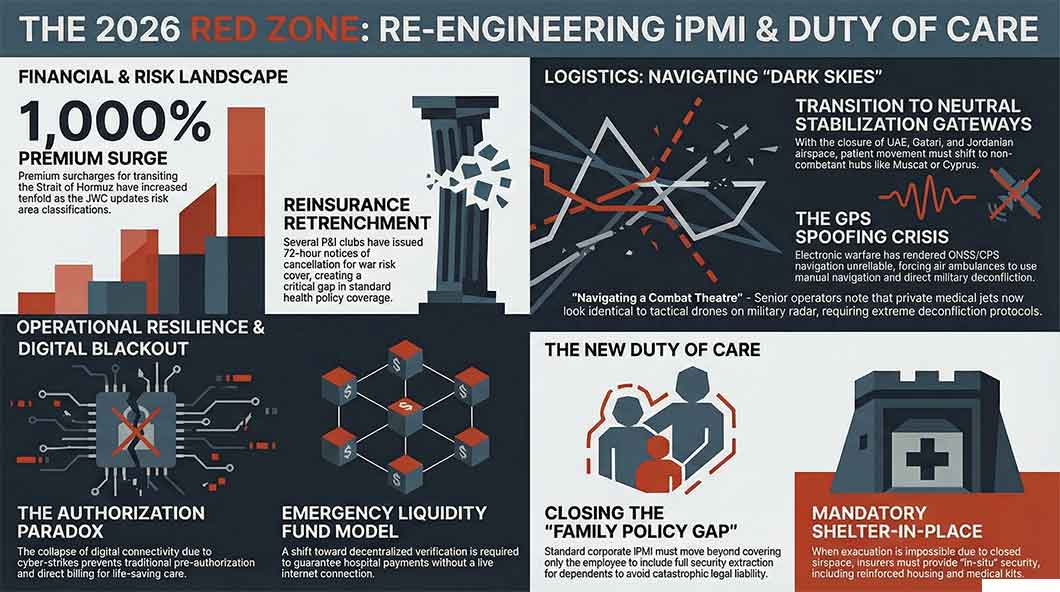
The Loss of "Safe Hubs": Former Tier 1 safe zones like Dubai, Abu Dhabi, and Doha are now on the front lines. This has caused commercial reinsurance to retrench, triggered massive premium surcharges, and created terrifying coverage gaps for catastrophic events like missile strikes on residential towers.
Paralyzed Medical Evacuations: The closure of major civilian airspaces and widespread electronic warfare (such as GPS spoofing) have made navigating the region highly dangerous, paralyzing traditional medical repatriation efforts.
Digital Blackouts: Regional cyber-strikes have severed the digital connectivity required for pre-authorizations and direct billing. The industry must quickly solve this "Authorization Paradox" to figure out how to guarantee payment for life-saving trauma care when local internet networks are dark.
Urgent Duty of Care Failures: The industry needs to immediately address new ethical and legal liabilities, such as the "Family Policy Gap" that leaves dependents without extraction coverage. Furthermore, because airspace closures often make evacuation impossible, providers must establish mandatory "shelter-in-place" protocols to protect clients who are trapped.
Ultimately, the round table serves as a critical gathering for insurers, assistance groups, and medevac specialists to share confirmed operational intelligence, re-price the risk of this new "Red Zone," and ensure that the preservation of life remains the industry's primary mission
Executive Briefing
Because digital infrastructure and connectivity are failing, insurers must develop new offline methods for authorizing life-saving care and managing emergency payments. Furthermore, corporations are being forced to broaden their duty of care to include comprehensive protection and survival resources for dependents and families trapped in the region. Ultimately, these shifts signal a permanent end to low-risk expatriate life, necessitating a radical re-engineering of how global health and security providers operate.
The military operations of February 28, 2026—marked by the decapitation of Iranian political leadership and subsequent retaliatory strikes against the "glittering hubs" of the Gulf—have shattered the actuarial foundations of the Middle East insurance market. This is no longer a period of "heightened awareness"; it is a systemic shift to a full-scale regional war footing that has rendered two decades of underwriting data obsolete. For twenty years, the industry operated under the assumption of Gulf stability, treating the UAE and Qatar as extensions of the European "Tier 1" safety net. That paradigm died the moment the first missiles impacted the regional security architecture.
The financial fallout is characterized by a "10x Premium Surge," driven by a coordinated retrenchment across the global reinsurance market. As primary carriers grapple with the sudden evaporation of capacity, the Joint War Committee (JWC) has fundamentally reclassified the region.
This retrenchment is not merely a pricing adjustment; it is a structural withdrawal. With P&I clubs and reinsurers issuing 72-hour cancellation notices for war risk cover, a catastrophic coverage gap has emerged. In high-profile residential enclaves like Palm Jumeirah, standard iPMI policies are being tested by force majeure and "non-admitted coverage" complications. When a kinetic strike necessitates a multi-casualty extraction, the industry is discovering that financial indemnity is meaningless if physical evacuation is a tactical impossibility.
Aeromedical Evacuation in "Dark Skies"
The closure of civilian airspace across the UAE, Qatar, and Jordan has paralyzed the traditional logistics of medical repatriation. In this "Dark Skies" environment, the strategic pivot from routine air ambulance transfers to high-risk military deconfliction is a baseline requirement for any provider claiming to fulfil Duty of Care.
Underpinning this paralysis is the "GPS Spoofing Crisis." Widespread electronic warfare and the total unreliability of Global Navigation Satellite Systems (GNSS) have created an underwriting nightmare. Beyond the physical danger, spoofing represents an "uninsurable hazard"; it negates standard flight safety protocols and potentially triggers "gross negligence" clauses that complicate subrogation and claims.
As a senior operator from a leading European aeromedical institute noted: "We are no longer just flying patients; we are navigating a combat theatre where a private Learjet looks identical to a tactical drone on a radar screen."
To maintain operational viability, the industry is adopting the Neutral Stabilization Gateway model:
Tactical Staging Hubs: Establishing Muscat and Cyprus as the primary nodes for patient stabilization and secondary triage outside the immediate kinetic zone.
Ground-to-Air Transitions: Navigating the shift from aerial extraction to armoured ground transport, specifically managing the complex logistics of fortified land crossings at the UAE-Oman border.
Deconfliction Protocols: Utilizing manual navigation and direct military-to-civilian communication channels to bypass electronic warfare corridors that render digital cockpits useless.
Solving the "Authorization Paradox" and Digital Blackouts
Modern iPMI is built on a "thin thread" of digital connectivity—a thread that has been severed by sustained regional cyber-strikes. Telehealth, direct billing, and pre-authorization platforms are the first casualties of this conflict, creating a systemic failure at the point of care.
This has birthed the "Authorization Paradox": the protocol requirements for trauma centres in Kuwait or the UAE demand immediate financial guarantees, yet the insurer’s digital infrastructure is offline. To prevent a total collapse of the provider network, we are synthesizing the Emergency Liquidity Fund model, anchored in neutral territories like Muscat or Cyprus.
This model requires:
Decentralized Verification: Implementing offline cryptographic tokens or pre-distributed manual verification codes that allow hospitals to confirm eligibility without a live internet handshake.
Pre-Funded Liquidity Pools: Maintaining escrow accounts in neutral hubs to provide immediate capital injections to regional trauma centres, ensuring that the "preservation of life" is not delayed by a lack of real-time solvency checks.
Autonomous Clinical Authorization: Redefining contractual terms to empower local medical providers to initiate life-saving interventions that are pre-accepted by insurers, bypassing the need for traditional "thin thread" authorization during digital blackouts.
The New Frontier of Duty of Care: Ethical and Legal Mandates
The activation of "Crisis Registration Portals" by the Foreign, Commonwealth & Development Office (FCDO) and other global bodies signal more than just a diplomatic emergency; it signals a potential "piercing of the corporate veil" regarding liability. For global employers, the legal definition of Duty of Care has undergone a permanent, high-stakes expansion.
The "Family Policy Gap" is now the industry's most significant legal vulnerability. While standard corporate iPMI often covers the employee for security extraction, it frequently leaves dependents under basic, health-only riders. In the 2026 landscape, leaving families behind in a JWC Listed Area is a breach of the "Reasonable Care" standard under modern UK/EU employment law. This is no longer an optional benefit; it is a core liability requirement.
As airspace remains contested, "evacuation" has largely become a myth. This necessitates a transition to Mandatory Shelter-in-Place Protocols, where insurer responsibilities have shifted "in-situ":
Hardened Housing: Actuarial accounting for the reinforcement of residential compounds against kinetic threats and fragmentation.
Private Security Details (PSD): Provision of armed or high-level security for residential enclaves when local law enforcement is overstretched.
Sustenance and Life Support: The mandatory deployment of "in-situ" emergency medical kits and long-term survival supplies for personnel who cannot be safely moved.
Topic: Re-Engineering iPMI and Duty of Care for a Middle East at War
Participants: High-level executives from Insurers, Assistance Groups, Air Ambulance Operators, and Medevac Specialists.
Apply for a RT seat: ipmi@ipmimagazine.com
In this new era, the speed of operational intelligence is the only factor capable of outpacing the speed of conflict. Attendance is mandatory for those serious about surviving the Red Zone.
C Knight
iPMI Global
+44 20 8068 4042
email us here
Visit us on social media:
LinkedIn
YouTube
Why Attend an iPMI Global Round Table?
Legal Disclaimer:
EIN Presswire provides this news content "as is" without warranty of any kind. We do not accept any responsibility or liability for the accuracy, content, images, videos, licenses, completeness, legality, or reliability of the information contained in this article. If you have any complaints or copyright issues related to this article, kindly contact the author above.
